Relationships & Sexuality
When Sex Starts Feeling Like a Test You Have to Pass
Men struggling with sexual performance anxiety rarely walk into therapy saying they are anxious. What looks like a body problem is often a quieter story about worth, masculinity, and the cost of always having to perform.
May 21, 2026 · 3-4 min read
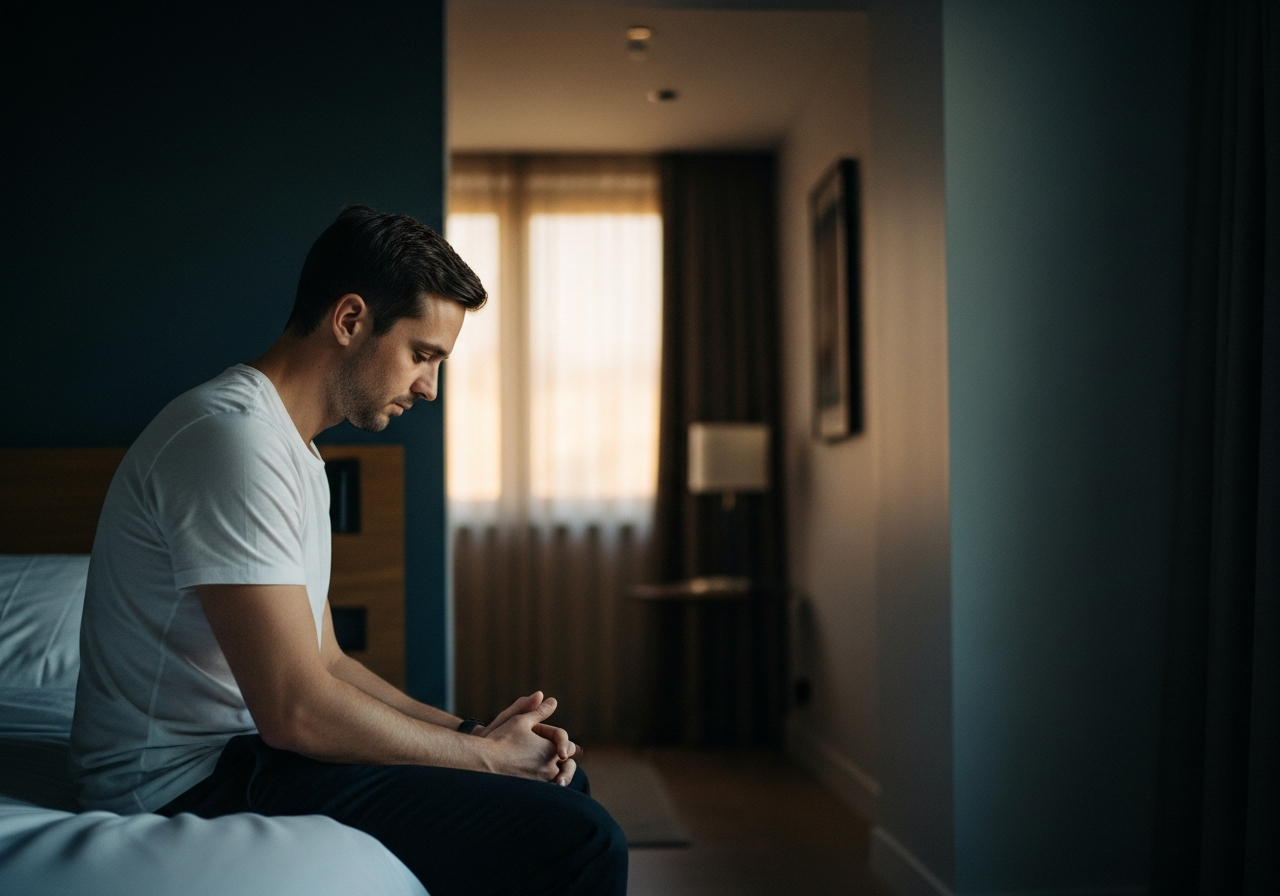
Men struggling with sexual performance anxiety rarely walk into therapy saying, "I think I have anxiety."
They say something more composed. More polished.
"I don't know what's wrong with me." "It only happens sometimes." "I'm attracted to her, so that's not the issue." "I've had the medical tests done. Everything is normal."
And from the outside, their lives are usually working.
They are successful. Effective. Operating under pressure with ease. In most areas of life, pressure is precisely what has made them succeed.
That is part of where the problem begins.
Because performance anxiety is rarely just about sex. It is about what sex represents.
For a lot of men, intimacy is one of the few places that cannot fully be navigated through strategy, control, achievement, or competence. You cannot perform your way into emotional safety. And the body does not respond well when it is being managed like a quarterly target.
The more a man watches himself during intimacy, the less present he becomes. The less present he is, the more disconnected the experience feels. The more disconnected it feels, the more pressure walks into the room next time.
This is why reassurance from a partner usually does not resolve it.
A partner can say "it's okay" ten times, but inside, the man may have already translated the moment into something far harsher:
I failed. I'm losing my masculinity. I'm letting her down. I'm losing control.
What I find striking as a psychologist is how often men do not realize how quietly their identity has been organized around being dependable, competent, and emotionally contained. Especially high-functioning men. Especially expats in cities like Dubai, where life often becomes a continuous loop of performing, optimizing, and proving.
That is when sexual anxiety becomes psychologically threatening — because it exposes something unfamiliar: vulnerability without a script.
And men often respond to that vulnerability in ways that quietly make the problem worse.
They overthink. They search online endlessly. They avoid closeness. They reduce sexual initiation. Or they over-focus on fixing the body while ignoring the emotional meaning attached to the experience.
Sometimes the problem is not low desire. Sometimes it is fear.
Fear of embarrassment. Fear of dependence. Fear of not being enough when there is no competence left to hide behind.
This is also why these difficulties can show up suddenly in men who never had them before. New relationships, emotional closeness, stress, burnout, unprocessed shame, a history of betrayal, body-image concerns, or simply starting to genuinely care about someone — all of it can shift the emotional stakes entirely.
What matters to understand is this:
Your body is not always broken. Sometimes it is just sending a signal.
Treating performance anxiety is not about pep talks or teaching a man to "just relax." In my work, the deeper focus is usually on understanding the private emotional logic underneath the anxiety itself. What the experience means to you. What feels threatened. And what role masculinity, worth, control, and closeness have played in your life for a long time.
Because when we understand that, it usually stops feeling random.
And when something stops feeling random, people usually stop feeling ashamed of it.
Topics: Sex, Performance Anxiety, Relationships, Men